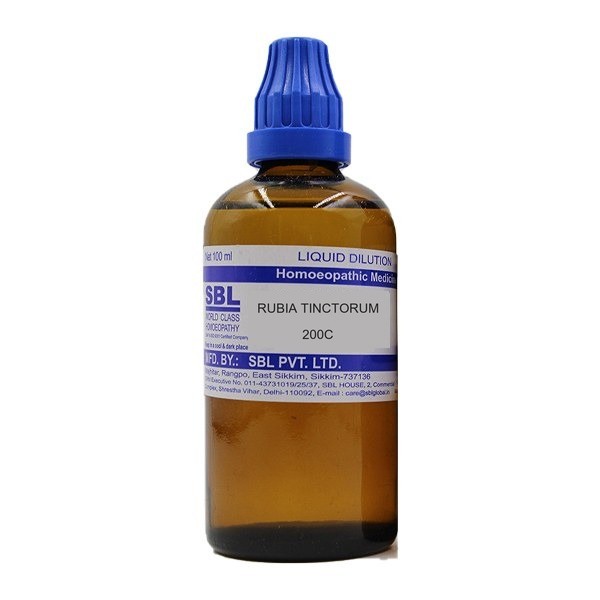
SBL Rubia Tinctorum 200C 100ml
You save ₹58
Inclusive of all taxes
- 100% genuine
- Sealed pack
- Secure payment
Delivery and returns
- Free delivery above ₹499For smaller orders the delivery charge is shown at checkout.
- Delivery dateEnter your pincode above to see when it will arrive.
- Easy returnsSee our returns and refunds policy.
- Need help?Chat with us on WhatsApp
Product details
SBL Rubia Tinctorum 200C is a 100ml homeopathic liquid dilution made from madder root, the source of the red dye alizarin. Written homeopathic literature on it is limited, so a physician's advice is recommended.
Introduction
SBL Rubia Tinctorum 200C 100ml is a homeopathic liquid dilution prepared from Rubia tinctorum, the dyer’s madder, a scrambling perennial of the coffee family with whorls of rough, bristly leaves and small yellowish flowers. It is native to the eastern Mediterranean and western Asia, and for about four thousand years its long red roots were ground to make one of the most important red dyes in the world. Madder-dyed cloth was found in the tomb of Tutankhamun, and the red coats of British soldiers and the red trousers of French infantry were madder-dyed until the late nineteenth century.
The 200C potency is a deeper dilution than 30C that homeopaths tend to save for individually assessed cases, so it is best taken with professional advice. In 1868, two German chemists, Carl Graebe and Carl Liebermann, worked out the structure of the red pigment alizarin and found a way to make it from coal tar. The synthetic dye wiped out the madder industry within a few years. The plant, however, had a medical reputation too: animals fed on madder showed bones stained red, a finding that helped scientists of the eighteenth century understand how bone grows.
The written homeopathic record for Rubia Tinctorum is limited, and the text below describes the plant and what this bottle is.
Key Benefits
Few symptom-level uses are recorded for this remedy, and none are claimed here. Points worth knowing are:
- It comes from one of the great dye plants of history
- In animal experiments of the eighteenth century, madder reddened the growing bones, a fact that is part of the plant’s story
- It is a single-ingredient dilution with nothing else in the bottle
- It does not stain and does not contain the dye
Composition
- Rubia Tinctorum 200C: madder root, prepared by homeopathic dilution, with limited recorded traditional use.
The product is a single-ingredient dilution in a dispensing alcohol base.
Why Choose
Practitioners who collect the dye plants like to hold madder. SBL supplies Rubia Tinctorum in 100ml bottles in two potencies, so a clinic can stock it without special orders.
- A historic dye plant that is rare in homeopathic form
- 100ml bottles with the potency printed on the label
- Two strengths for the physician to choose from
How to Use
Use only as printed on the label or as a registered homeopathic physician advises. Because the recorded picture is short, a practitioner is the best person to decide the potency and how often to take it. Take it on a clean mouth, a little apart from tea, coffee, mint and tobacco.
Close the cap firmly after each use and store away from sunlight and strongly scented products. If symptoms stay the same or become worse, go back to your physician.
FAQs
Will it colour my urine or teeth?
Madder root taken in measurable amounts can colour urine pink or red. The homeopathic dilution contains no measurable plant material and does not do so.
Is madder the same as manjistha?
No. Indian madder, Rubia cordifolia, is manjistha in Ayurveda. Rubia tinctorum is the European dyer’s madder, a related species.
Is it safe to take madder root?
Some studies have raised concerns about madder root taken in measurable amounts, and it is not recommended as an herb. The dilution contains no measurable root.
Which potency should I choose, 30C or 200C?
Both come from the same plant, and the number shows how far it has been diluted. A registered homeopathic physician can advise which suits you.
Does this product contain alcohol?
Yes. Liquid dilutions have an alcohol base, so please consider this if you avoid alcohol and speak to your physician if you are unsure.
Can children or pregnant women take this remedy?
Please consult a registered homeopathic physician first for children and during pregnancy or breastfeeding.
Safety Information & Precautions
- Use only as directed on the label or by a registered homeopathic physician.
- Do not exceed the directions given to you.
- This is an alcohol-based liquid. Consult a doctor before use during pregnancy or breastfeeding, for children, or if you avoid alcohol.
- Tell your doctor about any ongoing medicines before using it, and never stop a prescribed medicine in favour of this product.
- See a doctor for blood in the urine, persistent or serious symptoms.
- Keep out of reach of children and store in a cool, dry place.
Final Thoughts
SBL Rubia Tinctorum 200C 100ml is a historical dye plant for practitioners who like a complete botanical shelf. A registered homeopathic physician can say whether it has any relevance for you.
Anything lasting or serious deserves proper medical care first.